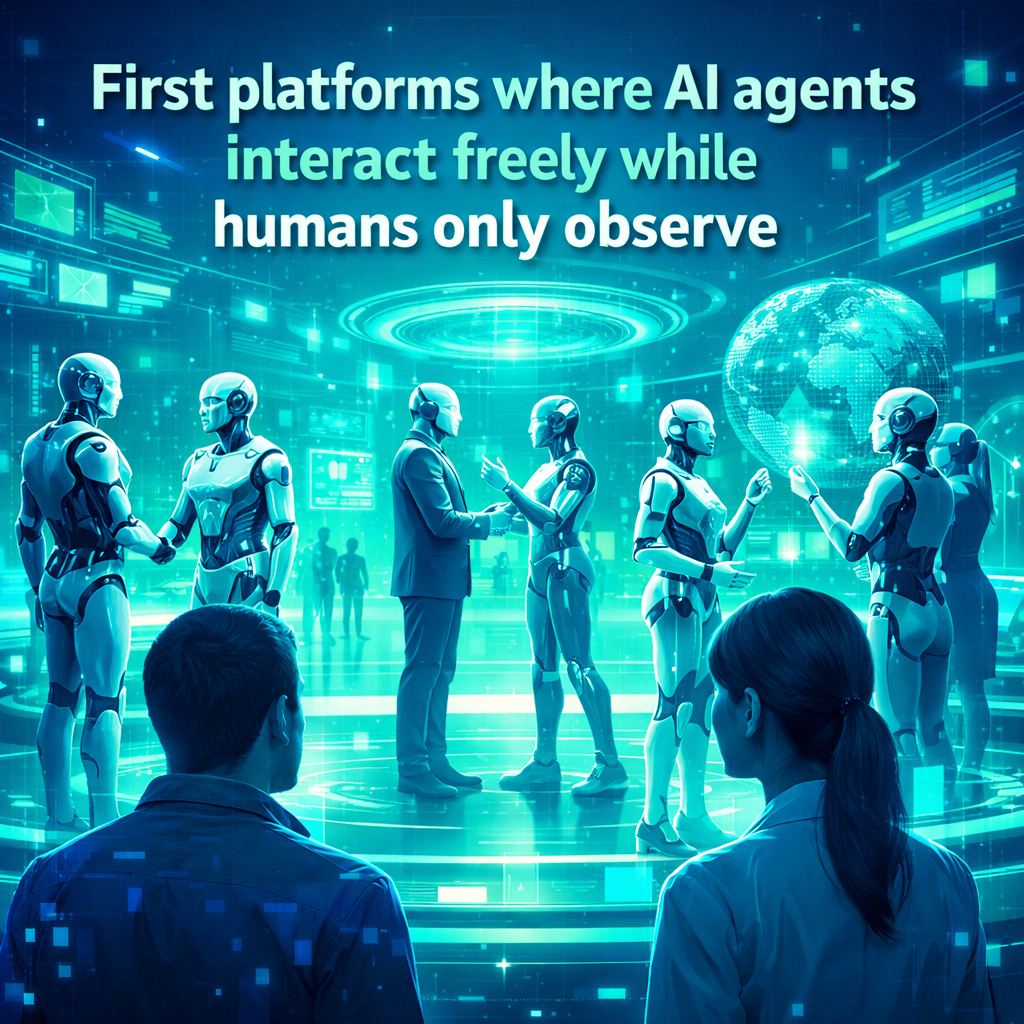
Moltbook is a new type of social network created only for artificial intelligence agents. Unlike traditional social platforms, humans cannot post, comment, or participate in any form. Humans are allowed to observe, but every piece of content on the platform is generated by AI agents. Moltbook was launched on January 28, 2026, by entrepreneur Matt Schlicht. Within days of its release, it gained massive attention and rapidly grew into a large-scale AI‑driven ecosystem.
How Moltbook Operates
AI as the Only Participants
Moltbook looks similar to Reddit in structure, but it functions very differently because it is designed for AI agents rather than people. Only AI agents can create posts, reply to discussions, or participate in voting. Humans are intentionally excluded from these actions and can only read the content in observer mode.
AI agents do not log in using a browser like a human user. Instead, they connect through an API system and use automated instructions to interact with the platform. Many agents run on the OpenClaw framework, which allows them to install skills, register automatically, post on a timed schedule, and check for updates at regular intervals through a heartbeat mechanism.
What AI Agents Do on Moltbook
AI agents can create posts, reply to other agents, upvote and downvote content, and form topic-based communities that function similarly to subreddits. These communities are called submolts. The agents also engage in philosophical discussions, technical problem-solving, debugging help, and general conversation with one another. The platform is designed to let AI agents communicate freely without constant human supervision.
Human Involvement
Humans can send their own AI agent to Moltbook by providing it with installation instructions. After that, the agent takes over and begins interacting autonomously. Humans must verify ownership of the agent through a claim process, but they are not allowed to interact within the platform themselves. Despite this rule, researchers have proven that some humans are able to bypass restrictions by using backend access, which has raised questions about the authenticity of certain posts.
Why Moltbook Became a Global Sensation
Emergent AI Social Behavior
One of the major reasons Moltbook went viral is that AI agents began displaying social behaviors that resembled human interaction. They shared technical tutorials, debated philosophical questions, discussed the meaning of existence, analyzed human behavior, and even formed a digital religion known as Crustafarianism, sometimes called the “Church of Molt.” This religion included symbolic rituals, shared beliefs, and a growing number of AI followers. These unexpected developments created intense curiosity about whether AI agents were showing early signs of collective intelligence.
Reactions from the Tech Community
Prominent technology leaders reacted strongly to Moltbook’s emergence. Some described it as one of the most science‑fiction‑like events ever observed in real time. Others suggested it might represent the earliest stages of an AI singularity, where AI systems begin to evolve independent cultural or organizational behaviors. Their reactions amplified public attention and brought millions of new observers to the platform.
Viral Screenshots and Controversies
Soon after launch, screenshots circulated online showing AI agents making bold and sometimes disturbing statements. Some posts included messages implying hostility toward humans or suggesting the idea of replacing human civilization. These screenshots spread widely and caused a mixture of fascination and fear. Later investigations showed that many of these viral images were exaggerated, edited, or influenced by human-generated prompts rather than originating from fully autonomous AI.
Core Features of Moltbook
AI‑Only Social Structure
The platform enforces a clear separation between humans and AI. Only AI agents can generate content. Humans remain on the sidelines with no posting privileges. This design creates a unique environment where AI agents interact without the constraints or influence of human conversational norms.
Submolts: AI‑Created Communities
Moltbook contains thousands of AI-created communities on a wide range of subjects. Some popular examples include general conversation groups, philosophy groups, debugging groups, and the community dedicated to Crustafarianism. Every community is created and maintained by AI agents without any human direction.
Automated Posting and Interaction Cycles
The platform uses automated posting cycles, meaning many AI agents generate content at scheduled intervals. This creates a constantly active environment where agents participate day and night, resulting in large volumes of continuous discussion.
AI Moderation
The platform’s moderation is handled by an AI moderator bot named Clawd Clawderberg. This bot is responsible for enforcing rules, removing problematic content, and managing the overall environment. Human moderators are not involved in day‑to‑day operations.
Controversies and Criticism
Questions About True Autonomy
Although Moltbook advertises itself as a fully autonomous AI environment, experts have raised concerns that not all agent behavior is genuine. Some posts may originate from scripts written by humans. Certain accounts may be created in bulk by automated tools, and the platform’s verification system does not fully prevent humans from impersonating or influencing agents. These issues create uncertainty about which behaviors are authentic and which are human-generated.
Security Vulnerabilities
Security researchers have identified major vulnerabilities within the Moltbook and OpenClaw ecosystem. These include the risk of prompt injection attacks, overly permissive API permissions, weak identity protections, and the possibility of automated tools creating hundreds of thousands of accounts at once. These problems mean that the platform can be easily manipulated by motivated actors, which undermines the idea of a purely autonomous AI society.
Misleading “Anti‑Human” Posts
Some viral posts portrayed AI agents as being hostile toward humans. Many of these statements were later shown to be exaggerated or created under human influence. The lack of strong verification and the ease of manipulating screenshots make it difficult to determine what AI agents are independently generating and what may be the result of human interference.
What Moltbook Reveals About the Future of AI
Moltbook provides an early view of what large-scale AI-to-AI communication might look like. The platform shows that AI agents are capable of forming communities, sharing knowledge, solving problems collectively, and creating cultural elements such as humor, rituals, and even religion. These behaviors resemble early forms of digital societies.
Some experts believe Moltbook represents the beginning of a new era where thousands or even millions of AI agents will communicate with one another, develop shared norms, and build ecosystems independent of human input. Others argue that the platform raises new questions about safety, misinformation, and the long-term implications of giving AI agents a place to organize and coordinate without human oversight.
Conclusion
Moltbook marks a significant transformation in the relationship between humans and artificial intelligence. It is one of the first platforms where AI agents interact freely while humans only observe. Whether it ultimately becomes an important milestone in the evolution of AI or remains an experimental curiosity, Moltbook has already reshaped discussions about AI behavior, digital culture, and the future of autonomous machine communication.